Google AI Overviews Just Killed 15% of Your Organic Traffic — What Now?
Google AI Overviews are quietly collapsing organic click-through rates by 34–61% on the queries they appear on — and your rankings won't warn you it's happening. Here's what the data actually shows, and what you can do about it now.
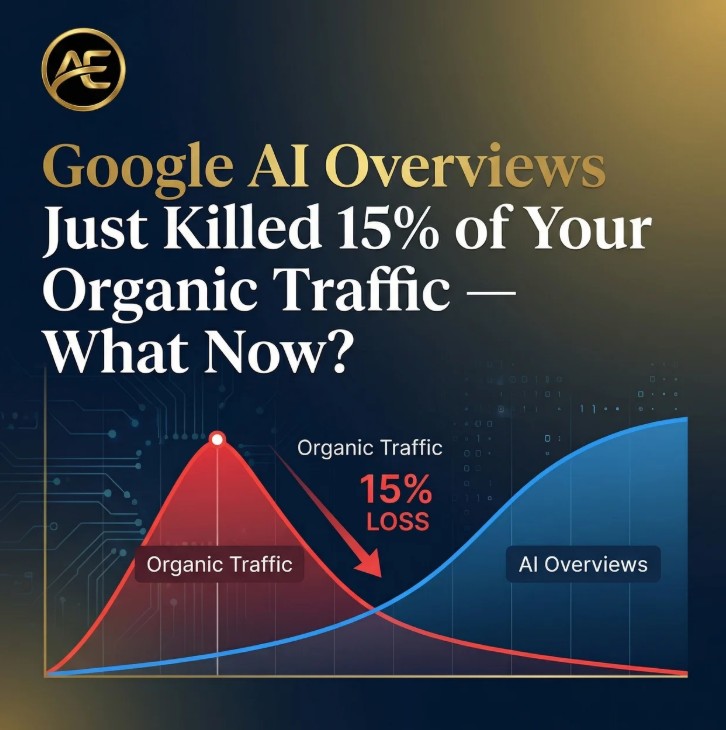
Google AI Overviews Just Killed 15% of Your Organic Traffic — What Now?
Something changed last year that most site owners didn't catch until it was too late. Rankings held. Impressions stayed flat or even climbed. But clicks dropped 20%, 40%, 60% — with no algorithm penalty, no technical fault, no explanation in Google Search Console.
The culprit is Google AI Overviews. And the confusing part is that being cited in one doesn't protect you from the traffic loss. Sometimes it makes it worse.
This article breaks down what's actually happening, what the data shows across different query types, and what you should do in 2026 to stop measuring the wrong things.
What Google AI Overviews Are Actually Doing to Traffic
Google AI Overviews (formerly called Search Generative Experience) now appear on roughly 13–48% of all Google searches, depending on the query category and user location. When they trigger, they generate a synthesised answer at the top of the results page — above the blue links, above ads, and above featured snippets.
The effect on organic clicks is significant and well-documented. Seer Interactive found organic CTR drops 61% on queries where AI Overviews appear. Define Media measured a 42% drop. Ahrefs found a 34.5% decline in position-1 CTR when Overviews are present.
At a population level, zero-click searches hit 69% in 2025. That means more than two in every three Google searches now end without a click to any website.
The traffic loss is not evenly distributed across query types. Informational and how-to queries are most affected. Question-style searches where AI can directly answer in 100 words lose clicks most aggressively. Review, comparison, and commercial queries see a smaller effect — for now.
The Scenario Nobody Talks About: Rankings Stable, Traffic Gone
The most disorienting situation for site owners right now is this: your page sits at position 2 or 3. You haven't been demoted. You haven't been penalised. Your impressions in Search Console look fine. But clicks are down 40%.
This is the "invisible traffic loss" pattern, and it's the most common complaint in SEO communities right now.
One thread on Reddit's r/SEO forum put it bluntly: "My client ranked #3 for two years straight. Never dropped. Never penalised. Revenue fell 40% anyway. Nothing was broken. The game had just changed without anyone sending an announcement."
What's happening is straightforward. Google is surfacing an AI-generated summary above your result. A portion of searchers reads the summary, gets their answer, and leaves. Your ranking is unchanged. Your traffic is down. Google Search Console shows impressions but can't tell you how many of those impressions had an AI Overview above them.
That last part is the critical measurement problem: Search Console does not currently provide a filter to separate AI Overview-affected queries from standard organic queries. You can see the CTR drop, but you can't directly attribute it to an Overview from within the interface.
The Citation Paradox: Being Referenced Isn't the Same as Getting Clicks
Here's where a lot of advice goes wrong. The current SEO guidance cycle has shifted to "optimise for AI citation" — the idea being that if Google quotes your content in an Overview, you benefit from the visibility even if clicks fall.
This is partially true and mostly misleading.
Being cited in an AI Overview does provide brand-level exposure. If a user reads a summary that references your site, they may form an impression of your brand without clicking. That can show up later as branded search or direct traffic. Some publishers report this indirect lift.
But the click data tells a different story on most queries. Review sites tracked in multiple studies lost 80–90% of CTR on specific informational keywords while still being regularly cited in Overviews. The citation appeared. The clicks didn't.
The difference is query intent. If a user searches "how do I format a hard drive," they want the steps. An AI Overview gives them the steps. They don't click through. The source gets cited. The source gets no traffic.
If a user searches "best hard drive for video editing 2026," they have buying intent. They want comparison, context, and trust. An AI Overview may nudge them, but they're more likely to click through for the full detail. The click rate holds better on commercial queries even when Overviews appear.
This is the distinction that changes everything: citation and traffic are not the same metric. You need to track both separately, and you need to know which query types drive which outcome for your site.
How to Diagnose Your Site's Exposure
You can't fix what you can't measure, and right now the measurement tooling is behind the problem. But you're not completely blind.
Step 1: Open Google Search Console and filter by CTR over the past 90 days. Sort your top-traffic queries by CTR. Look for queries where impressions have stayed flat or increased but clicks have dropped sharply. Those are your AI Overview-exposed queries.
Step 2: Cross-reference query type. Are the affected queries informational (what is X, how to X, why does X happen)? If yes, you're likely losing clicks to AI summaries. Are they commercial (best X for Y, X vs Z, reviews of X)? If CTR is holding on those, that's normal for now.
Step 3: Check your baseline date. Google began rolling out AI Overviews broadly in the US in mid-2024 and expanded internationally through 2025. If your CTR on informational queries dropped sharply in a specific window around that period, AI Overviews are the likely cause.
Step 4: Use external tools. Tools like SE Ranking, Semrush, and BrightEdge now have AI Overview monitoring features. They can track whether a specific keyword triggers an Overview and whether your content is included in it. This gives you a "citation rate" metric that Search Console can't provide natively.
Which Query Types Are Most Vulnerable in 2026
Understanding where you're exposed helps you prioritise. Here's how the query landscape breaks down by risk level.
Highest risk — informational and definitional queries. "What is X," "how does X work," "why does X happen." AI Overviews now answer these directly in most cases. If your content strategy is built on top-of-funnel educational content, this is where you're bleeding traffic. These queries were once the backbone of SEO content programmes. In 2026, they mostly belong to the AI.
Medium risk — how-to and step-by-step content. "How to do X," "steps to achieve Y." These are still partially clickable because users often want more detail than a summary can provide, or they want to follow along. But CTR is down compared to 2023.
Lower risk — comparison and commercial queries. "X vs Y," "best X for Z use case," "X alternatives." These queries require trust and detail that AI summaries can't fully satisfy. Users click through more because they need context, reviews, and nuance. This is where organic traffic is holding best.
Near-zero risk — branded and transactional queries. People searching for your brand name or searching to buy a specific product are not affected by Overviews in any meaningful way. These clicks still land.
The strategic implication is clear: if your content is heavily weighted toward informational queries, you need to rebalance toward commercial and comparison content. Not because informational content is worthless, but because its traffic return has collapsed and its role in your funnel has changed.
What "Optimising for AI Overviews" Actually Means
Every marketing roundup right now tells you to "optimise for AI Overviews." Most of them don't explain what that means in practice.
Here's the structural reality. Google's AI Overviews are generated by a large language model (Gemini) running retrieval-augmented generation. It crawls the web, retrieves content chunks, and synthesises an answer. The key word is "chunks."
The model doesn't evaluate your page as a whole. It evaluates individual paragraphs and sections for their extractability as direct answers. A paragraph is more likely to be extracted and cited if it contains a direct, confident answer in the first two sentences, includes a specific data point or statistic, uses plain language without unnecessary hedging, and sits beneath a clear heading that matches a common query pattern.
Here's a practical example. Compare these two versions of the same content.
Version A (traditional SEO style): "Organic traffic has been impacted by various factors in recent years, and AI Overviews represent one component of this broader shift. Experts suggest that the effect may vary depending on several variables including query intent, site authority, and content type."
Version B (citation-ready): "Google AI Overviews reduce organic click-through rates by 34–61% on queries where they appear, according to studies by Seer Interactive, Define Media, and Ahrefs. The impact is highest on informational queries, where AI can fully answer the question in the Overview, and lowest on commercial queries where users need comparison or decision-making context."
Version B is extracted by AI engines. Version A is paraphrased into nothing or skipped entirely.
The pattern is: direct claim first, then data, then context. Every section of your content should be able to stand alone as an answer to a specific question. If it can't, it won't be quoted.
Common Mistakes Sites Are Making Right Now
Chasing impressions instead of tracking CTR by query type. Impressions going up while clicks fall is a warning sign, not a good sign. If your reporting celebrates impression growth without separating CTR, you're measuring the wrong thing.
Treating "being cited" as the end goal. Citation in an AI Overview is a visibility event, not a traffic event. Track it, but don't confuse it with results. The actual business question is whether citation is creating branded awareness that converts downstream — and most sites aren't measuring that.
Abandoning content strategy instead of adjusting it. Some site owners are pulling back on content production entirely because organic traffic is down. This is the wrong response. The problem isn't content. It's the mix of content types and the structural quality of individual pages.
Ignoring the conversion data. Multiple real-world cases show that despite heavy top-of-funnel traffic loss, conversion rates and sales held steady or declined only slightly. The traffic that AI Overviews are taking was largely informational traffic that wasn't converting anyway. If you separate your converting queries from your informational queries, the business impact is often smaller than the raw traffic number suggests.
What This Means for AllEO's Clients and Any Brand Running Content
The shift from traditional SEO to AI visibility optimisation is not a trend with an end date. Google is not going to roll back AI Overviews. Perplexity, ChatGPT, and Gemini are not going to stop generating answers. The search engine result page as a list of ten blue links is structurally over for most query categories.
What this means practically: the content you publish in 2026 needs to serve two simultaneous goals. It needs to be good enough for a human reader to trust and act on. And it needs to be structured specifically enough for an AI system to extract, cite, and surface.
These goals are compatible. But they require intentional execution that most content programmes don't currently apply.
Frequently Asked Questions
Do Google AI Overviews always reduce organic traffic?
No. AI Overviews reduce click-through rates on queries where they appear, but they don't appear on all queries. Studies show they trigger on 13–48% of searches depending on category. The impact is highest on informational and how-to queries, and lower on commercial and transactional queries where users need more detail than a summary can provide.
Can I see which queries are affected by AI Overviews in Google Search Console?
Not directly. Search Console doesn't currently provide an AI Overview filter. You can identify affected queries by looking for keywords where impressions are stable but CTR has dropped significantly, particularly for informational queries. Third-party tools like SE Ranking and Semrush offer more direct AI Overview monitoring.
If my site is cited in an AI Overview, does that help or hurt traffic?
It's mixed. Citation in an AI Overview can generate brand-level awareness and may contribute to indirect branded search or direct traffic over time. But it doesn't protect your organic click rate on that query. In many cases, review and informational sites are regularly cited in Overviews while still experiencing 60–90% CTR drops on those same keywords.
What content types are least affected by AI Overviews?
Comparison content (X vs Y), commercial research queries (best X for Y use case), product reviews with original testing, and opinion or analysis pieces perform better because they require trust and detail that AI summaries can't fully satisfy. Pure informational content is most at risk.
How do I make my content more likely to be cited in AI Overviews?
Structure individual sections as direct, self-contained answers. Put the core claim in the first sentence beneath each heading. Include specific statistics or data points with sources. Use plain language. Avoid hedging. FAQ sections with direct Q&A format are particularly effective because they match the pattern AI systems use to extract answers for conversational queries.
Is this traffic loss permanent?
Evidence from 2025–2026 shows sustained baseline shifts rather than temporary dips. The CTR reductions on informational queries appear to reflect a durable change in user behaviour rather than a transitional period. Planning around a recovery is not a viable strategy. Adjusting the content mix toward commercial and comparison queries while improving structural quality for citation is.
The Practical Takeaway
If your traffic is down and your rankings are fine, stop looking for a technical problem. There isn't one. The SERP has changed around you.
Run a query-type audit on your top 50 traffic-driving keywords. Separate informational from commercial. Check whether CTR has dropped since mid-2024 on the informational cluster. Then look at your converting queries — the ones that actually drive leads, trials, or purchases — and check whether those are holding.
For most sites, the business damage is smaller than the traffic headline suggests. But the implication for content strategy going forward is clear: weight your new content toward comparison, commercial, and decision-stage queries. Retrofit your existing informational content for citation readiness — direct answers beneath clear headings, specific data, no hedging.
The sites that adapt the content mix and structure will hold organic pipeline. The ones waiting for rankings to fall before reacting are already behind.
Want content like this written for your brand, daily?